The Archives
-
leadership, Management, Marketing, social media, Travel & Tourism
To be Authentic
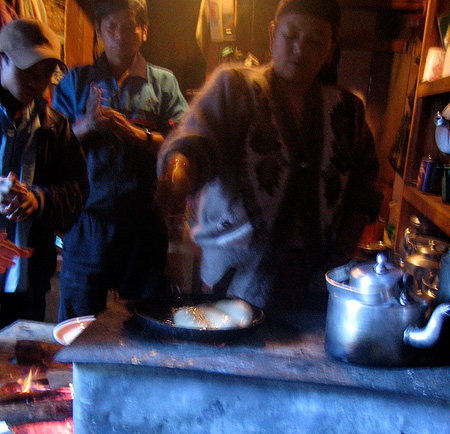
The best meal I ever had wasn’t at a fancy restaurant, made by a celebrity chef, with an award winning wine. It was at a small B&B in Chame, Nepal. Because it was freezing cold we huddled around the kitchen fire where dinner was being made.
The whole family helped out. Kids were preparing veggies, the husband was making the dough for bread and mom was in charge of everything and everybody. Friends and family came and went.
That Dal Bhat was the best meal I’ve ever had. Because it was an authentic experience.
The word authentic keeps popping up lately. Tourists increasingly want authentic experiences. In social media, you need to be authentic to be successful. To be authentic is to be real and genuine.
Simon Sinek, who writes fantastic stuff about leadership by the way, talks about imperfection and authenticity in this blog post.
Perfection comes out of molds or off assembly lines. Things made by nature or by hand are imperfect. It is their flaws that make these objects unlike any other of their kind. It is their imperfections that make these things unique and beautiful.That’s why so much marketing is junk. People try to make it too perfect and as a result, the message isn’t authentic anymore. It’s like most marketing comes from the same assembly line. Killed by process, approvals and egos.
Imperfection is not always a bad thing, when it creates authenticity. Keep this in mind for your business. Don’t mold it like everybody else’s (but don’t use your bathroom as a place for imperfection). Give staff some room to be themselves so they don’t sound like robots and give them the ability to think on their feet and give customers personalized attention.
And in social media, authenticity is a must. Don’t always try to craft the perfect message. Be yourself and try to have meaningful relationships with your network. Just don’t be stupid. And when you make a mistake, apologize.
I’ll finish by quoting Simon one more time.
Great leaders don’t try to be perfect, they try to be themselves. And that’s what makes them great. -
Marketing, social media, Travel & Tourism
Something to talk about
06.17.10 | Permalink | 3 Comments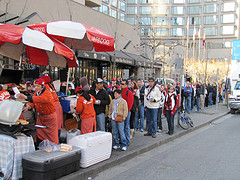
What do travellers talk about after they’ve experienced your tourism business or destination?
In Vancouver, we have many hot-dog vendors. They’re all the same. Some have more condiments than others. That’s pretty much the only difference.
Then this new hot-dog vendor called Japadog popped up. Right in front of our office. Every day, when I leave for lunch, there’s a line-up. The vendor across the street has nobody waiting.
Why? What’s the difference?
Japadog does hot-dogs different. Their menu includes hot-dogs with seaweed, soy, edamame, bonito flakes, fried cabbage and other Japanese goodness.
Everybody’s talking about Japadog. People take pictures and post them on Flickr and Facebook. People talk about it on Twitter. Brag about it on blogs.
What will people talk about when they’ve experienced your business of destination? When an experience is mediocre, there’s nothing to talk about. But with a little creativity, you can give people a reason to talk, tweet and post, giving others a reason to visit.
-
Internet, social media
Social Media and the path to conversion
06.16.10 | Permalink | 2 CommentsI was watching a keynote from Gary Vaynerchuk the other day and in his special style he basically said that people shouldn’t jump to fast to conversion in social media but work on building relationships first and business will follow.
My conclusion:
- Social Media is about relationships
- Relationships build trust
- Trust generates business
Building trust is about integrity, telling the truth, being transparent, helpful, reliable, unselfish and fair. Whether you’re a big brand or a small operator, if you and your staff behave in the ways above, you’ll be one step closer to social media happiness.
-
Internet, social media
Facebook down for a week!
03.18.10 | Permalink | 4 CommentsGot your attention didn’t it?
This is purely a hypothetical scenario. It’s also an experiment in dual-blogging (think bloggers meet dual-pianists in Vegas). Rodney Payne from Think! and I are going to be hypothesising about the effects of Facebook shutting down for a week. Instead of commenting on each other’s blogs, we’re going to be posting each other’s responses as a blog.
[WB] Day 1. The Facebook URL stops responding. First thing that happens is an insane amount of activity on Twitter reporting the news. After that all hell breaks loose in the tech blogosphere; Mashable, Inside Facebook, All Facebook, Techcrunch, Techmeme et all just go crazy over the news. Traditional media follows a few hours behind.
[RP] Day 2. Facebook led last night’s evening news and is splashed across the front page of newspapers worldwide. Twitter traffic has more-than-doubled overnight with almost every tweet referencing #Facebook. Tweets have largely replaced status updates. New account registrations have grown significantly. The ‘Twitter Whale’ is displayed frequently to show that Twitter is slow and overwhelmed with traffic. Cell-phone carriers and email providers see a noticeable increase in messages. Blogs are filled with stories guessing at what’s going on.
[WB] Day 3. Everybody who threw a party and used Facebook Events to organize the party is ticketed off because nobody showed up. The first “Life without Facebook” t-shirts are starting to appear. ‘Experts’ on the news networks make suggestions about how to deal with Facebook detox. Facebook is scheduling a new conference for the next day.
[RP] Day 4. People realize that life A.F. (after Facebook) isn’t too scary. Facebook isn’t a matter of life-and-death like internet banking or email. It’s just a convenient social tool. Productivity at offices has surprisingly decreased slightly because many people can’t focus on one task without some distraction. Employees who had learned to collaborate using Facebook messages and Facebook chat are now forced to return to slower methods of communication.
[WB] Day 5. Facebook promises the network will be back up soon. Some businesses complain drops in sales because of a reliance on Fanpages and Facebook ads. Legal action is discussed. Flickr reports an increase in new accounts and uploaded photos. Some kids fear their Farmville animals will die.
[RP] Day 6. You would have thought that with 450 million people addicted to social networking and gaming that a rival-site would rise to meteoric success. However, MySpace hasn’t seen too much of a bump in traffic, commentators think its because of the lack of privacy built into people’s social graph. People who log in to their old accounts find a social wasteland with no posts from legitimate friends and just a scattering of links leading to creepy websites. People are beginning to think that Facebook may never come back online. Google Buzz and Orkut are getting an increased trickle of new users but its just not the same, all of our photos and friends were on Facebook.
[WB] Day 7. Media has nothing left to talk about and tech bloggers are too busy with the latest Apple iSomething. People stop caring about it. Life goes on without Facebook although they wonder what their friends are up to. Facebook announces service will be restored tomorrow and blames a proprietary Microsoft product for causing the crash of it’s service.
[RP] Day 8. The reckoning is upon us. Zuckerberg flicks the switch and issues a press release to that affect which is picked up by every single news organization in the world. Facebook blows past its previous 30% of web traffic to attract over 50% of internet users. Facebook’s servers overload and go down for another hour or two. When they come back online, people connect again, pay-per-click ads resume, and Farmville animals are revived just in time… Life goes on.
-
Internet
Must see presentations #4: Blaise Aguera y Arcas: Bing’s augmented-reality maps
03.16.10 | Permalink | 3 CommentsI saw Blaise’s first Photosync presentation at Web 2.0 in 2006 and was utterly impressed. He’s now working on Bing maps. This explains why Bing Maps is getting better and better and better.
His presentation at TED recently is a must see.It shows how Bing (and Google) Maps have become so much more than simple mapping tools. And the innovation will continue relentlessly. Let your imagination go wild after watching this presentation. What will Google and/or Bing Maps look like 5 years from now?
-
Marketing, Travel & Tourism
Mickey’s 10 Commandments
11.16.09 | Permalink | 2 CommentsI’m working on an idea I’ve had for a long time with the working title “Disneyworld as the perfect DMO”. Here’s a piece of knowledge from Disney every DMO or travel business can copy-and-paste and hang on their walls.
Mickey’s 10 Commandments
- Know your audience – Don’t bore people, talk down to them or lose them by assuming that they know what you know.
- Wear your guest’s shoes – Insist that designers, staff and your board members experience your facility as visitors as often as possible.
- Organize the flow of people and ideas – Use good story telling techniques, tell good stories not lectures, lay out your exhibit with a clear logic.
- Create a weenie – Lead visitors from one area to another by creating visual magnets and giving visitors rewards for making the journey
- Communicate with visual literacy – Make good use of all the non-verbal ways of communication – color, shape, form, texture.
- Avoid overload – Resist the temptation to tell too much, to have too many objects, don’t force people to swallow more than they can digest, try to stimulate and provide guidance to those who want more.
- Tell one story at a time – If you have a lot of information divide it into distinct, logical, organized stories, people can absorb and retain information more clearly if the path to the next concept is clear and logical.
- Avoid contradiction – Clear institutional identity helps give you the competitive edge. Public needs to know who you are and what differentiates you from other institutions they may have seen.
- For every ounce of treatment , provide a ton of fun – How do you woo people from all other temptations? Give people plenty of opportunity to enjoy themselves by emphasizing ways that let people participate in the experience and by making your environment rich and appealing to all senses.
- Keep it up – Never underestimate the importance of cleanliness and routine maintenance, people expect to get a good show every time, people will comment more on broken and dirty stuff.
Martin Sklar, Walt Disney Imagineering, Education vs. Entertainment: Competing for audiences, AAM Annual meeting, 1987
-
Uncategorized
Twitter for Travel and Tourism: Wrapping my head around it
01.10.09 | Permalink | 24 CommentsI’ve been trying to wrap my head around what the opportunity is exactly for a Destination Marketing Organization like Tourism BC. Here’s where I’m at. I welcome your input.
Twitter is social, so it’s up to an individual to choose to follow somebody. To a bit of understanding about what would motivate somebody to follow a DMO, I posted a short survey on Twitter. I didn’t get near enough responses to give it statistically valid results (n<100) but its something (feel free to fill it out and re-tweet).
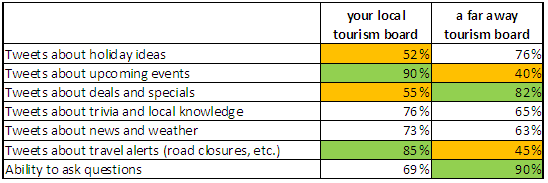
My hypothesis that there’s a difference between what people expect from a local or a far away tourism board seems to be true. Locals are interested in current information while long haul visitors look for ideas, deals and help in trip planning. Makes sense, people’s needs depend on the level of knowledge about a destination.
My open question “Anything else you want to share about what a Tourist Board can do for you via Twitter?” resulted in some interesting insight (appended in the rest of by entry in italics below). They’re in line with some ideas I have:
Twitter as a customer service centre
how about a “virtual” Visitor Information Centre/counsellor where visitors could ask questions about what to do, etc.
Comcast’s Frank Eliason is universally hailed for his ComcastCares account where Comcast customers can ask questions or get help with service problems. Many DMO’s already sun visitor centres and/or call centres. Twitter is another channel for communication.
I wonder how this would scale though as Twitter grows. Creating a network of Twitterers in a destination, each as an expert for a particular area or sector is one option. It doesn’t have to be a DMO representative answering the question, there are plenty of local experts out there. Building the network and distributing questions is the role of the DMO.
Pro-actively sharing information
insider info about the place like favourite bar for a martini, celebrities visiting, bits of history
Sends you on a “5 second holiday” each day with breathtaking photos.
This falls more into the broadcasting category and that means you need to be careful because it’s easy for people to perceive your message as spam and unfollow you as a result. But as the survey above show, there’s appetite for this information. So how to go about it?
Twitter is about information sharing. But quality, quantity, frequency and communication style are important. I’ve been active on Twitter for almost two year and here are my observations.
Add links. Pointing to quality information is key to Twitter. Don’t just link to your own website. Be diverse. By using a URL shorterner with reporting features like budURL or Cl.igs, you can measure the quality of your tweets by the number of clicks it receives.
Frequency. Don’t post one tweet after another but space your informational tweets. You can use a tool like Tweetlater to schedule tweets. I use it for my ‘Good Morning’ tweets to cool BC photos. People are creatures of habit and people will look remember similar pieces of information at a regular time of the day.
Communication style. Just like all social media, the communication style needs to be conversational and authentic. No marketing talk; this message is from a person on behalf of a company. Companies can’t talk.
The quality of information needs to be good. This is very subjective of course, and learning through trail and error is probably your best bet. Measuring re-tweets (what’s retweet) is another good way of measuring the quality of your information.
Find a personal connection
Ask me questions and engage me.
An important realizations came to me last week when Meg from Finger Lake sent me the following message:@wilhelmus we have a winery named after you in the Finger Lakes! http://w ww.wilhelmusestate…. 🙂Twitter is about personal communication. Broadcasting general information is hit an miss for people. But if you make a personal connection, either through a gimmick (like my name) or an interest, the communication becomes a lot more meaningful. Again, scaling is tough. We receive millions of visitors to our website. There’s no way we can develop a personal relationship with every person on Twitter. But our network of tourism partners certainly can. The operator ultimately delivers the experience after all.
Use the Twitter community
Take suggestions – ask us what the best cafe is in Revelstoke or great family camping etc.
Twitter is a community. People build their their network by following and being followed by other people. As a DMO, you need to work just as hard at your network as other people. When you create a thriving network, the network is the marketer, not the DMO. As a DMO, you can activate this by engaging the network as suggested above. Your network needs to include a diversity of ‘local experts’ that you can use to assist and connect with people.
This is where Twitter excels. It’s how David Armano raised thousands of dollars for a friend in need. It’s how Twitter is rapidly becoming a channel for live witness news.
Conclusion
Twitter can be a valuable tool for DMO’s by providing information and support for travelers and potential travelers. It’s important to understand Twitter is a social channel and not a broadcast channel. The personal and one-on-one communication style of Twitter is hard to scale. That’s why it’s important to build a network of people from your industry and past travelers and passionate residents you can activate.
Build your network and start engaging people. Use re-tweets to find the right person to assist and inform potential travelers. You can also use search and alerts to find people with questions that relate to your destination or related tourism experiences. -
Internet, Travel & Tourism
Is there a place for a destination based Social Network?
11.19.07 | Permalink | 8 CommentsThere are opinions floating around about the viability and usefulness of destination based Social Networks. Karin Schmollgruber for example doesn’t have a lot of faith in a social network for a single destination.
A touristic social network is not about a destination, but about travelers of that destination. Which in turn means, that a community cannot be established around a destination. It has to be created around the emotions, experiences, likes and dislikes of real people.Karin is one of the thought leaders in the travel 2.0 blogging community and I respect her opinion a lot. But I disagree with her about this one. I think the CoolAustria and Holland 2.0 experiments have taught us a few lessons. But I don’t reach the same conclusion.
The destination based Social Networks mentioned above (and now Sweden as well) all implemented some form of “be like Facebook” strategy, combined with a plethora of Web 2.0 tools. The core challenge with this approach is that travelers who are planning trips need information and don’t necessarily want to become part of another Social Network, create a profile, make friends and more, they just want to plan a vacation.
With Holland as an exception, these social networks are also separated from their official websites, a huge missed opportunity. The result from all of the above is that all these networks suffer from low participation, where high participation is needed. facebook is great, but a ‘be like Facebook’ approach is not going to work for a destination. Karin is absolutely right about that.
Some suggest that travel related social networks is just another source for content. Simply aggregate User Generated Content from third party networks, and you’re done. New Zealand has done it, Canada has done it. This is definitely useful content for travelers. And I like simplicity, but I don’t like to oversimplify things. I thought Web 2.0 was about interactivity and two way communication. Aggregating User Generated Content and publishing it on a website is Web 1.5.DMO’s need to build strong relationships with consumers, and help them plan and book vacations, before and during their trip, by allowing all relevant stakeholders to participate on a destination website. These stakeholders are:
- Travelers, planning a trip, or sharing experiences and content about a trip
- Residents, they are a sub-group of travelers, but a very important one
- The tourism industry, selling their tourism products
- The DMO itself, providing the ‘official’ information
The opportunity for a destination based social network is to harness industry, passionate residents and past travelers, and engage them in a dialog with travelers to assist them with their trip planning. This is a natural extension of what DMOS’s do. They sell the destination by connecting travelers with tourism product (connecting supply with demand). Destinations already have relationships with their industry. They need find and encourage their ‘brand advocates’ to engage on their networks.
Groups for cities, towns, sectors, etc. will form. There will be differences of opinion, and that’s ok. That’s how trip planners can evaluate the opinion of many against their own criteria and make the best decision. Certain content can be sourced from third parties. What’s the point of creating your own product rating system when you can source it directly from Tripadvisor for example. Other content will have to be created on a destination based social network.
With the introduction open social standard, there is an opportunity to leverage existing networks people are already part of. If somebody can take their social graph with them, all of a sudden we can leverage the existing connections (friends) people already have, adding a whole layer of additional usefulness and credibility.
The social network I envision and intent to create for HelloBC.com is a mash-up of our official information, aggregated third party content, combined with our resident advocates, passionate past travelers and tourism businesses, all interacting with travelers in an open and transparent way. The direct, and two-way interaction is an opportunity to add the credibility, objectivity and authenticity travelers are looking for. And it will be nothing like Facebook.

William Bakker's Destination Marketing blog
William Bakker is Chief Strategist at Destination Think!. These are my personal thoughts.