I’ve been trying to wrap my head around what the opportunity is exactly for a Destination Marketing Organization like Tourism BC. Here’s where I’m at. I welcome your input.
Twitter is social, so it’s up to an individual to choose to follow somebody. To a bit of understanding about what would motivate somebody to follow a DMO, I posted a short survey on Twitter. I didn’t get near enough responses to give it statistically valid results (n<100) but its something (feel free to fill it out and re-tweet).
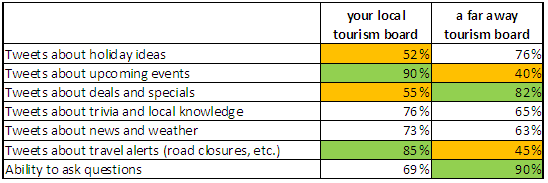
My hypothesis that there’s a difference between what people expect from a local or a far away tourism board seems to be true. Locals are interested in current information while long haul visitors look for ideas, deals and help in trip planning. Makes sense, people’s needs depend on the level of knowledge about a destination.
My open question “Anything else you want to share about what a Tourist Board can do for you via Twitter?” resulted in some interesting insight (appended in the rest of by entry in italics below). They’re in line with some ideas I have:
Twitter as a customer service centre
how about a “virtual” Visitor Information Centre/counsellor where visitors could ask questions about what to do, etc.
Comcast’s Frank Eliason is universally hailed for his ComcastCares account where Comcast customers can ask questions or get help with service problems. Many DMO’s already sun visitor centres and/or call centres. Twitter is another channel for communication.
I wonder how this would scale though as Twitter grows. Creating a network of Twitterers in a destination, each as an expert for a particular area or sector is one option. It doesn’t have to be a DMO representative answering the question, there are plenty of local experts out there. Building the network and distributing questions is the role of the DMO.
Pro-actively sharing information
insider info about the place like favourite bar for a martini, celebrities visiting, bits of history
Sends you on a “5 second holiday” each day with breathtaking photos.
This falls more into the broadcasting category and that means you need to be careful because it’s easy for people to perceive your message as spam and unfollow you as a result. But as the survey above show, there’s appetite for this information. So how to go about it?
Twitter is about information sharing. But quality, quantity, frequency and communication style are important. I’ve been active on Twitter for almost two year and here are my observations.
Add links. Pointing to quality information is key to Twitter. Don’t just link to your own website. Be diverse. By using a URL shorterner with reporting features like budURL or Cl.igs, you can measure the quality of your tweets by the number of clicks it receives.
Frequency. Don’t post one tweet after another but space your informational tweets. You can use a tool like Tweetlater to schedule tweets. I use it for my ‘Good Morning’ tweets to cool BC photos. People are creatures of habit and people will look remember similar pieces of information at a regular time of the day.
Communication style. Just like all social media, the communication style needs to be conversational and authentic. No marketing talk; this message is from a person on behalf of a company. Companies can’t talk.
The quality of information needs to be good. This is very subjective of course, and learning through trail and error is probably your best bet. Measuring re-tweets (what’s retweet) is another good way of measuring the quality of your information.
Find a personal connection
Ask me questions and engage me.
An important realizations came to me last week when Meg from Finger Lake sent me the following message:
Twitter is about personal communication. Broadcasting general information is hit an miss for people. But if you make a personal connection, either through a gimmick (like my name) or an interest, the communication becomes a lot more meaningful. Again, scaling is tough. We receive millions of visitors to our website. There’s no way we can develop a personal relationship with every person on Twitter. But our network of tourism partners certainly can. The operator ultimately delivers the experience after all.
Use the Twitter community
Take suggestions – ask us what the best cafe is in Revelstoke or great family camping etc.
Twitter is a community. People build their their network by following and being followed by other people. As a DMO, you need to work just as hard at your network as other people. When you create a thriving network, the network is the marketer, not the DMO. As a DMO, you can activate this by engaging the network as suggested above. Your network needs to include a diversity of ‘local experts’ that you can use to assist and connect with people.
This is where Twitter excels. It’s how David Armano raised thousands of dollars for a friend in need. It’s how Twitter is rapidly becoming a channel for live witness news.
Conclusion
Twitter can be a valuable tool for DMO’s by providing information and support for travelers and potential travelers. It’s important to understand Twitter is a social channel and not a broadcast channel. The personal and one-on-one communication style of Twitter is hard to scale. That’s why it’s important to build a network of people from your industry and past travelers and passionate residents you can activate.
Build your network and start engaging people. Use re-tweets to find the right person to assist and inform potential travelers. You can also use search and alerts to find people with questions that relate to your destination or related tourism experiences.