The Archives
-
Internet, Marketing, Travel & Tourism
Take-aways from VisitBritain’s social media presentation
Somebody emailed me this webcast where Justin Reid from VisitBritain shares their social media strategy, examples, results and learning. Very insightful. Here are my key take-aways.
People don’t make a travel decision on a national tourism board website
Justin said: “Our research told us that the majority of long haul travelers visit a national tourist board after they’ve already made the decision to visit”
VisitBritain’s rightly concluded that in order to target people in the decision making process, they need to engage in other places like third party websites. A content partnership with Yahoo is working very well for them for example.
The future of CRM/eMail Marketing is under threat
Justin said: “Where previously you might have focused a lot of CRM activity we learned that the inbox is no longer a happy place. People want to clear it out as fast as possible. So we now want to focus on finding places where people are in the mindset of making decisions about travel [social media].”
I wondered about the same thing about a year ago in this blog post. As people become overwhelmed with email, they pay less attention to marketing messages, even when they opt-in. This kind of change won’t happen overnight but social media is an environment where people are easier to engage, two-way dialogue is possible and content is easy to share.
Social Media’s network effect has incredible reach
Justin: “10,000 followers is amazing. But we followed the traffic of some of our tweets and each of our tweets reaches a potential audience of about 325,000 people”
Through re-tweets on Twitter, and by tagging and sharing on Facebook, a message can travel far and wide in a very short period of time. And the content itself is much more credible because it’s endorsed by a friend who shared it.
Tourism Australia’s fanpage with over 600,000 fans is a good example. Every message they posts could be read by that many people. And for every person that comments on the post, the post gets published to their friend network, extending reach with the potential to organically grow their fanbase.
And as a side-effect, “Facebook is now the third largest referrer to VisitBritain after Google and Yahoo, and we’re not even seeking to push people to the website.”
Content is far more important than a website
Justin: “Our website is not the most important marketing tool for us, our content is. We’re just as happy if somebody reads our content on Yahoo as on our website.”
VisitBritain is agnostic about where content is being consumed and as a result, more of VisitBritains content is being consumed on third party websites. A partnership with Yahoo produces an exponential amount of views, for free. More videos are viewed than some market websites receive visitors.
Producing or gathering the right content, and pushing it out into place where you add value for the publisher and the consumer, preferably with easy sharing opportunities is much more effective than trying to generate website visitation through advertising alone.
User Generated Content is an easy and cost-effective way to publish content
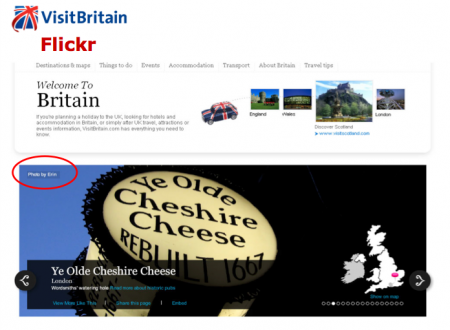
Justin: “95% of VisitBritain’s photography comes from user generated content” and “when somebody’s photo appears on a national tourism boards site, you can bet on it they will send a link to all their friends to check it out.”
VisitBritain set-up a Flickr group called Love UK and is using it as one of the sources for its photos on VisitBritain.com. And because most people are happy to see their photography used, they will tell everybody about it.. on social media.
Brilliant. This is something I’ve advocated for years but I could never get it going. Well done VisitBritain.
Thanks for sharing Justin!
-
Internet, Marketing, Travel & Tourism
Advergaming: an interview with VisitOslo’s Katrine Mosfjeld
01.13.10 | Permalink | 3 Comments
Katrine Mosfjeld from VisitOSLO
Katrine Mosfjeld has been the Manager of the Tourist Information Division at VisitOSLO for 8 years. She manages online and offline information delivery to consumers ranging from Tourism Information Centres, to digital strategies, visitOSLO’s Twitter account and a booking system. She works closely with industry in Oslo and even delivers an eLearning program.
I met Katrine in Amsterdam at the ENTER conference last year where I was really impressed with the tremendous success of their Advergaming strategy. When I started to play the game I immediately understood the success. It’s super addictive! She just released a second version and I thought I’d catch up with her.
You’ve been executing an advergaming strategy with the Holmenkollen Ski Jump. What gave your team the idea to use an advergaming strategy?
I wish I could say it was my idea, but it wasn’t. The supplier, an Oslo based little firm called Agens, got the idea and first contacted our colleagues at VisitNorway to see if they were interested. They were, and the Manager, Hans Petter Aalmo, invited us at VisitOSLO to discuss the idea and potential. This was back in the summer of 2006. As you can imagine, this was pretty new 3,5 years ago and the project group was not sure if it was going to work. But we liked the idea and we had a good feeling about it. So we decided to try something brand new… The stakes were high, but then the gain is good as well if you succeed right?
When did it first launch and what were the objectives?
We launched it December 21, 2006. You can still play it online. We decided to measure our success in numbers of games played (profiling the ski jump, Oslo and Norway each time) and visitors to the sponsor websites. But we never even dreamt about the results we got. Or all the other stuff that happened…
What were the results and what was all the other stuff that happened?
The numbers we got were incredible! And they are still growing every single day. At the moment, 138,800,000 games have been played, which means 277,600,000 jumps because every game has 2 jumps :). It has also generated more than 3,000,000 visits to our websites. How great is this??! Neither VisitOSLO or VisitNorway has ever done anything more efficient when it comes to marketing and results. And the other things that happened, but never thought of while planning…
- lots of media attention for the game, I’ve counted more than 20 articles
- we won a prize for the best game on a Norwegian gaming site 123spill.no
- 2 different Facebook groups created by fans
- some 40-50 people have been recording themselves and uploaded their videos on YouTube, like this one. Make sure to check out the related videos 🙂
- There have been blogs written about the game as a phenomena, and the Norwegian Ski Jumping team has blogged that this is what they do when they don’t work out or compete in the real stuff 🙂
- lots of tweets on Twitter
- the widget has been installed on many websites and blogs
- we’re even included in the ETC eMarketing book
You just launched a new version. What’s new and how are things going so far?
It’s a pretty tough act to follow because the first game was so successful! But we’re building a new skijump in Oslo, the new fantastic Holmenkollen Ski Jump, designed by JDS Arcitechts and wanted the game to reflect the new ski jump and brand. We launched it December 16th 2009 and you can play it here. It has been played 9,6 million times on the website already, with great viral effects in Facebook-posts, tweets, etc!We also launched a Facebook app where you can play against your Facebook friends to see who’s the better jumper ;-). It has been played approximately 1 million times on Facebook since we launched December 21st. An advanced version of an iPhone app has been sold over 2000 times since December 24th.
The game has been tweeted a gazillion times, received TV coverage on the news, sports, papers, blogs, Facebook and YouTube… It has generated 66,500 visitors to the sponsor websites.
The results look very good so far, especially considering it was launched only a few weeks ago. We expect it to deliver results for many years; the old game is more than 3 years old, and still delivers. Yesterday there were 342,000 games played in the OLD game 🙂 Pretty efficient, eh?
What advise would you give to destination marketers who’re thinking about advergaming?
We’ve experienced that it is extremely efficient – but it has to be a good idea, and done professionally. We also think that our success partly comes because it is fairly addictive :). It is a bit difficult to play, but not too difficult. You quickly understand some of the things that makes you better, so you want to try again. And it doesn’t feel to commercial – even if its marketing, you feel that it’s a game, and it is a game. Only it has some messages attached, and provides some links when the interest is created 🙂
Thank you very much for sharing your insights Katrine and congratulations with the success of the game.
You can follow Katrine on Twitter. Curious about the game? You can watch the video below but you really should play it.
-
Internet, Marketing, Travel & Tourism
The end of the DMO/CVB website? Europe says yes.
10.23.09 | Permalink | 7 Comments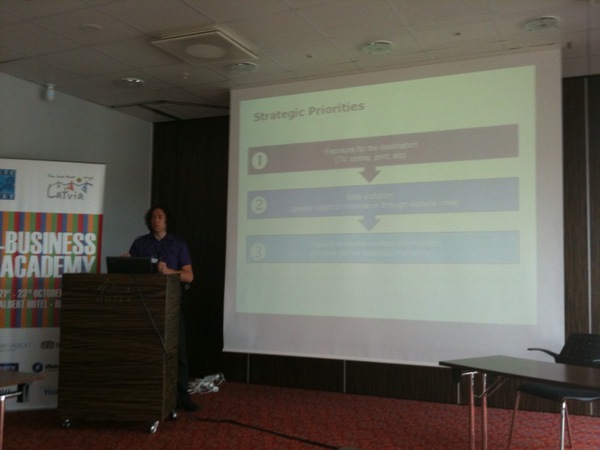
With websites such as Tripadvisor, WAYN, Google Maps, Facebook, etc., do DMO/NTO/CVB’s need websites at all 10 years from now? Brand new director Armands Slokenbergs from the Latvian Tourism Development Agency asked for a show of hands and nobody raised even a finger. After 3 days of presentations and discussions it’s hard to ignore the fact that we need to go where the consumer is, instead convincing the consumer to come to us.I was fortunate to have the opportunity to present some of my ideas and join about 50 online marketers from 25 European National Tourism Organizations for 3 days during their annual eBusiness Academy. The theme of the conversations was focussed on working with 3rd party websites to provide content and in the case of social networks, join the conversation. Isabel Mosk from Holland noted that “instead of asking to ‘please buy Holland’, we should be asking ‘how can Holland help you'”.
And the message from consumers is clear. You don’t help anybody traditional advertising but by adding value through relationships. Slokenbergs’ limited budget is focussed on encouraging word-of-mouth recommendations (bravo!). He shared some really cool research and one the conclusions was that the best opportunities for word-of-mouth is the though positive interactions between local people and their traditions. A great example is encouraging the celebration of your “Name Day” in Latvia; a local tradition that’s celebrated by everybody.
WAYN and Tripadvisor showed case studies of DMO campaigns. The WAYN campaign with South Africa was particulary impressive. A contest to win a trip (of course) resulted in 20,000 additions to South Africa’s consumer database at a very reasonable cost. The added bennefit was the community engagement who selected the winner and will probably be living vicaruasly through the (Canadian) winner when she goes on her trip soon.To go where the consumers are is working well for some NTO’s. VisitBritain receives 18.5M visitors to its consumer websites and an equal number of visitors via syndication partners. Other NTO’s are doing interesting things well including Slovenia who works with local search angines and portals. Many syndicate to Google Maps and have developed widgets.
Joobili co-founder Jared Salter shared some interesting thoughts. Not every destination is a top 5 destination year-round. But many destinations are the best destination at least one day a year during a really cool festival. Joobili satisfies the for consumers need who plan a trip based on what the best place to visit is for a particular date or dates. Great way to provide a sense of urgency as well.
Google’s Andrew Pozniak tried really hard to convince us that Google has no intentions to enter the travel vertical but we all know they already have. Not through a big bang, but slowly though Google Maps, Streetview, Place Pages, YouTube and secret Android activities.Isabel tweeted that we all might work for Google soon. But hey, if anybody is taking over from us, I hope it’s Google.
-
Internet, Travel & Tourism
Congratulations VisitSweden
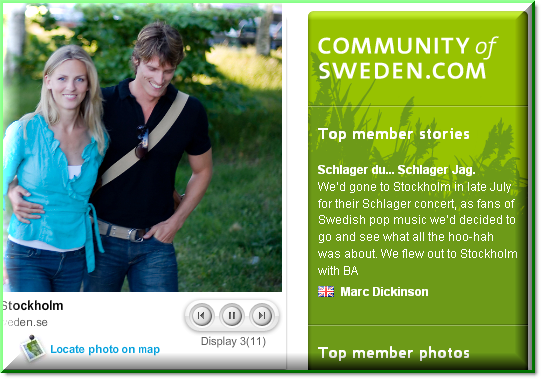
VisitSweden launched its new website this last Tuesday. Besides that is looks very nice, provides great content and a nice Google map, it is also integrating the content it has generated from it CommunityOfSweden social network.
I like this approach. It compliments the official content with user generated content (we do the same). I also like that they take small steps and evolve. They experimented with the social network, and now feel comfortable to start tying it closer to the flagship.
Well done Sweden!

William Bakker's Destination Marketing blog
William Bakker is Chief Strategist at Destination Think!. These are my personal thoughts.