» Next Entries
The Archives
-
Marketing, Travel & Tourism
Mickey’s 10 Commandments
11.16.09 | Permalink | 2 CommentsI’m working on an idea I’ve had for a long time with the working title “Disneyworld as the perfect DMO”. Here’s a piece of knowledge from Disney every DMO or travel business can copy-and-paste and hang on their walls.
Mickey’s 10 Commandments
- Know your audience – Don’t bore people, talk down to them or lose them by assuming that they know what you know.
- Wear your guest’s shoes – Insist that designers, staff and your board members experience your facility as visitors as often as possible.
- Organize the flow of people and ideas – Use good story telling techniques, tell good stories not lectures, lay out your exhibit with a clear logic.
- Create a weenie – Lead visitors from one area to another by creating visual magnets and giving visitors rewards for making the journey
- Communicate with visual literacy – Make good use of all the non-verbal ways of communication – color, shape, form, texture.
- Avoid overload – Resist the temptation to tell too much, to have too many objects, don’t force people to swallow more than they can digest, try to stimulate and provide guidance to those who want more.
- Tell one story at a time – If you have a lot of information divide it into distinct, logical, organized stories, people can absorb and retain information more clearly if the path to the next concept is clear and logical.
- Avoid contradiction – Clear institutional identity helps give you the competitive edge. Public needs to know who you are and what differentiates you from other institutions they may have seen.
- For every ounce of treatment , provide a ton of fun – How do you woo people from all other temptations? Give people plenty of opportunity to enjoy themselves by emphasizing ways that let people participate in the experience and by making your environment rich and appealing to all senses.
- Keep it up – Never underestimate the importance of cleanliness and routine maintenance, people expect to get a good show every time, people will comment more on broken and dirty stuff.
Martin Sklar, Walt Disney Imagineering, Education vs. Entertainment: Competing for audiences, AAM Annual meeting, 1987
-
Internet, Marketing, social media, tourism bc, Travel & Tourism
The DMO site as a social platform; moving closer
The future of DMO websites needs real time and social content. Yesterday, our Torch Relay Field Reporter program is a good example of a step towards real time content. And I use social in a broad sense. It means collaboration with people who have a personal or commercial interest in assisting potential travelers to visit a destination.
In our case, our province is a collection of regions, cities and communities; most with their own DMO. Last year our regions took a bold step and decided to use their region on HelloBC as their website. Instead of both spending time and money on development, content, SEO, SEM, etc, we’re now collaborating and HelloBC is better for it.
Most DMO’s are also using Twitter now. Twitter is a great way to connect our website visitors with local experts and give them real time information about regions and communities. So we’re starting to add the local DMO twitter feeds to the relevant pages of HelloBC.
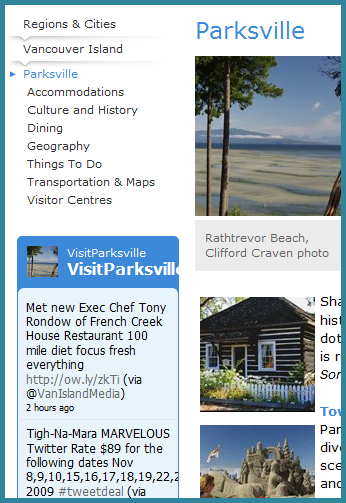
Parksville Twitter feed on HelloBC
Another step towards a more social and real time website.
-
Internet, Marketing, Travel & Tourism
The end of the DMO/CVB website? Europe says yes.
10.23.09 | Permalink | 7 Comments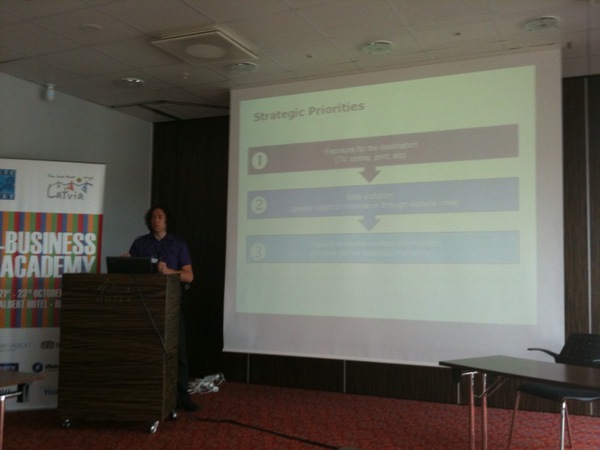
With websites such as Tripadvisor, WAYN, Google Maps, Facebook, etc., do DMO/NTO/CVB’s need websites at all 10 years from now? Brand new director Armands Slokenbergs from the Latvian Tourism Development Agency asked for a show of hands and nobody raised even a finger. After 3 days of presentations and discussions it’s hard to ignore the fact that we need to go where the consumer is, instead convincing the consumer to come to us.I was fortunate to have the opportunity to present some of my ideas and join about 50 online marketers from 25 European National Tourism Organizations for 3 days during their annual eBusiness Academy. The theme of the conversations was focussed on working with 3rd party websites to provide content and in the case of social networks, join the conversation. Isabel Mosk from Holland noted that “instead of asking to ‘please buy Holland’, we should be asking ‘how can Holland help you'”.
And the message from consumers is clear. You don’t help anybody traditional advertising but by adding value through relationships. Slokenbergs’ limited budget is focussed on encouraging word-of-mouth recommendations (bravo!). He shared some really cool research and one the conclusions was that the best opportunities for word-of-mouth is the though positive interactions between local people and their traditions. A great example is encouraging the celebration of your “Name Day” in Latvia; a local tradition that’s celebrated by everybody.
WAYN and Tripadvisor showed case studies of DMO campaigns. The WAYN campaign with South Africa was particulary impressive. A contest to win a trip (of course) resulted in 20,000 additions to South Africa’s consumer database at a very reasonable cost. The added bennefit was the community engagement who selected the winner and will probably be living vicaruasly through the (Canadian) winner when she goes on her trip soon.To go where the consumers are is working well for some NTO’s. VisitBritain receives 18.5M visitors to its consumer websites and an equal number of visitors via syndication partners. Other NTO’s are doing interesting things well including Slovenia who works with local search angines and portals. Many syndicate to Google Maps and have developed widgets.
Joobili co-founder Jared Salter shared some interesting thoughts. Not every destination is a top 5 destination year-round. But many destinations are the best destination at least one day a year during a really cool festival. Joobili satisfies the for consumers need who plan a trip based on what the best place to visit is for a particular date or dates. Great way to provide a sense of urgency as well.
Google’s Andrew Pozniak tried really hard to convince us that Google has no intentions to enter the travel vertical but we all know they already have. Not through a big bang, but slowly though Google Maps, Streetview, Place Pages, YouTube and secret Android activities.Isabel tweeted that we all might work for Google soon. But hey, if anybody is taking over from us, I hope it’s Google.
-
Internet, Marketing, Travel & Tourism
The Role of DMO and CVB Websites – Start with your website user
09.07.09 | Permalink | 2 CommentsThe role of our website is a favourite topic among senior management at Tourism BC and has been for a long time. PhoCusWright’s Destination Marketing: Understanding the Role and Inpact on Destination Marketers flared up another round last summer. I’ll spare you those details but here are some of my thoughts.
PhoCusWright rightfully notes that almost every DMO is different they way they’re structured, funded and organized but that key issues and challenges are very similar. I’ve been talking to my peers around the world for 10 years now and that’s definely true.And it’s becoming more challenging all the time. Online innovation continues are a rapid pace while a DMO website is now at the heart of all marketing activities. My perspective a user centered one. If you don’t meet your website user’s goals, there’s no hope you’ll ever meet any of your organizational or stakeholder objectives, because your visitors won’t stick around.
One place to start is to figure out where a person’s place is in the planning (or purchase) cycle.Find out if somebody:
- knows about the destination but is not considering a trip yet
- is considering a trip but doesn’t have concrete plans yet
- has decided to visit but hasn’t booked yet
- has booked and it filling in the details
- is in the middle of the trip, continuing planning
The answer to the question posed above could radically change the approach you should take. If most people are in the first group, they’re looking for a reason to visit. They need to be inspired. Big imagery, videos that connect on an emotional level and experiential stories work really well in this phase. Most DMO websites serve consumers in this phase very well.
But if somebody is in the third group, the role of the website is not to lose the sale. They’re already inspired and motivated. Most DMO websites don’t do very well here. When somebody visits a DMO website in this phase, it probably means there’s just a few nagging questions and they need answers. Details. How long does it take to drive there? How expensive is everything?Is the museum open on Mondays? Is there enough to do for the whole family?
Forget the emotional video and big images. The website can look like Craigslist. They just want detailed information (they could also be looking for a deal by the way, but that’s another poll to run).
PhoCusWright has polled consumers and their report includes valuable information about where consumers say they visit DMO websites in the process. We’ve polled our website visitors about this for a while now and our numbers are a bit different from PhoCusWright’s. This leads me to believe that it might vary based on the destination.
It’s super easy to find out where your visitors are in the process. Poll them. Find out. And use it internally as you discuss the role of your website. And get the PhoCusWight report, it’s worth the money.
-
Internet, Marketing, Travel & Tourism
More about Tourism BC’s Online Video Strategy: Field Reporters
10.26.08 | Permalink | 4 CommentsA few weeks ago I posted about our call for video field reporters. I also promised more details. Here we go.
Our video strategy is multi-faceted based on the opportunities that are currently available. Some are traditional and some are new. But they’ll all work together in a framework.
Let’s first examine the types of tourism related videos out there.
First, there’s the destination video. Emotional music, breathtaking scenery, friendly people, incredible experiences. The intent is to create a strong emotional connection with somebody. The content include all the core brand attributes and the target audience enjoying them. These videos are often used at consumer and/or tradeshows and most destinations have put these videos on their websites and video networks such as YouTube.
Destination Marketing Organization’s TV commercials are often a mini version of the destination video. Sometimes, they include a touch of humour or clever creative, like this video from Utah. But they always include all the core brand tributes again. Watch the Utah commercial and you know what they market and who they market to. Often there’s a call to action to visit a website, a fulfillment piece (guide) or a price point (often through a trade partner).
Then there are the travel host videos, as you will find on travel shows on TV. A host visits a destination and documents some of his or her experience in an informal documentary style. Usually all the “must sees” are covered. Sometimes, if it’s a special interest show, a specific experience is covered.
New on the scene are DMO created documentaries. These highlight a specific iconic experience of a destination. Often, there’s also a host involved and it’s informative and specific to an iconic experience.
And there are the user generated videos of course. Nothing is more credible than real experiences from real people. The amazing video above was the winner of the best user generated video at the eTourism awards last year.Each type of video has a specific purpose. From creating awareness through creating an emotional connection, to real and authentic experiences that makes somebody think “I can be part of this story”. We’re currently in the process of creating a new destination video, TV commercials and documentaries. We’re also encouraging consumers to share their videos with us on our blog section.
But what’s interesting is that we believe there’s room for an additional category, a variation of the travel host, with a user generated content feel. We call these “field reporter” videos. Last year we experimented with this concept.
The video above is one of our ski host video. The intent of the video was to create an authentic video but still hit on the core brand message. The result was positive. Chris did a great job and consumers responded positvice, but our key learning was that we created something that felt a bit off. It didn’t feel authentic, and it wasn’t a slick documentary either.Together for our agency (Cossette Communication Group) we re-defined the video host concept and renamed it to “field reporters”. The idea was to hire 6 people who with good personalities who can handle a video camera. We would send them out into all corners of BC and document their experiences. In order to make it authentic, they have to find somebody and ask for a recommendation. After the recommendation, they need to follow through and document their experience. Nothing planned, nothing staged. They had to be host, camera person and editor. We did add our logo at the beginning of each video to be transparent that we asked these people to create these videos.
And that’s what we’ve done over the last month. We found 7 very talented individuals and send each one to each of our 6 tourism regions, and one on a circle tour on his motorbike. We did give each a list of “iconic” tourism products so they had an idea what was going on in the area. They all made 5-7 videos each. We will use these videos on HelloBC to complement our existing content.
Below is a sample.
Here’s Chris climbing the Squamish Chief.
Ivan visited Bella Coola, and found a first nation person to take him to old Petroglyphs.
Kelli visited the Thompson Okanagan and hiked the Kettle Valley trail.
Mike visited the Kootenay Rockies and was told to visit Fort Steele and the Bull River Guest Ranch near Cranbrook.
Ami was told to take a train ride from Prince Rupert to Prince George through Northern British Columbia.
And Gary rode the Coast Cariboo Circle Tour his motor bike.
We’re also encouraging our staff, communities and industry to create their own videos. It’s easy enough to do. All you need is a video camera and some video editing software.
Some have already taken us up on the challenge. Clint from our Norther BC region create the video above.
And here’s our online team member Mikala’s visit to a farmers marketBy posting these videos on our blog, hopefully we’ll even inspire some BC residents and our travelers to give our their tips and insider information. The intent is to get many video’s capturing the diverse range of tourism experiences throughout the province. We will still use the destination video and professionally produced documentaries to get people excited, and the videos created by field reporters, industry, communities, staff and user will capture the details.
To watch all field reporter videos, keep an eye on Tourism BC’s YouTube channel and our Field Reporter playlist. Our field reporters are still editing some of their videos, so more will be added soon. -
Internet, Marketing, personal, social media, tourism bc, Travel & Tourism
My interview for Online Revealed Caribbean
10.14.08 | Permalink | 2 CommentsI was supposed to present with Richard Kunz from T4G, our technology solutions provider, at Online Revealed Caribbean. I couldn’t go unfortunately but Richard interviewed me and incorporated some of the footage in his presentation. I received some good feedback so I decided to put the whole interview online.
We discussed Web 2.0, user generated content, social networks and one-to-one marketing for Destination Marketing Organizations and the tourism industry. I shared some of the things we’re working with T4G on to provide more relevancy to individual consumers on a mass scale.
Richard and I will hopefully be at the next Online Revealed Canada in Niagara Falls on April 13-15. -
Internet, Travel & Tourism
Is there a place for a destination based Social Network?
11.19.07 | Permalink | 8 CommentsThere are opinions floating around about the viability and usefulness of destination based Social Networks. Karin Schmollgruber for example doesn’t have a lot of faith in a social network for a single destination.
A touristic social network is not about a destination, but about travelers of that destination. Which in turn means, that a community cannot be established around a destination. It has to be created around the emotions, experiences, likes and dislikes of real people.Karin is one of the thought leaders in the travel 2.0 blogging community and I respect her opinion a lot. But I disagree with her about this one. I think the CoolAustria and Holland 2.0 experiments have taught us a few lessons. But I don’t reach the same conclusion.
The destination based Social Networks mentioned above (and now Sweden as well) all implemented some form of “be like Facebook” strategy, combined with a plethora of Web 2.0 tools. The core challenge with this approach is that travelers who are planning trips need information and don’t necessarily want to become part of another Social Network, create a profile, make friends and more, they just want to plan a vacation.
With Holland as an exception, these social networks are also separated from their official websites, a huge missed opportunity. The result from all of the above is that all these networks suffer from low participation, where high participation is needed. facebook is great, but a ‘be like Facebook’ approach is not going to work for a destination. Karin is absolutely right about that.
Some suggest that travel related social networks is just another source for content. Simply aggregate User Generated Content from third party networks, and you’re done. New Zealand has done it, Canada has done it. This is definitely useful content for travelers. And I like simplicity, but I don’t like to oversimplify things. I thought Web 2.0 was about interactivity and two way communication. Aggregating User Generated Content and publishing it on a website is Web 1.5.DMO’s need to build strong relationships with consumers, and help them plan and book vacations, before and during their trip, by allowing all relevant stakeholders to participate on a destination website. These stakeholders are:
- Travelers, planning a trip, or sharing experiences and content about a trip
- Residents, they are a sub-group of travelers, but a very important one
- The tourism industry, selling their tourism products
- The DMO itself, providing the ‘official’ information
The opportunity for a destination based social network is to harness industry, passionate residents and past travelers, and engage them in a dialog with travelers to assist them with their trip planning. This is a natural extension of what DMOS’s do. They sell the destination by connecting travelers with tourism product (connecting supply with demand). Destinations already have relationships with their industry. They need find and encourage their ‘brand advocates’ to engage on their networks.
Groups for cities, towns, sectors, etc. will form. There will be differences of opinion, and that’s ok. That’s how trip planners can evaluate the opinion of many against their own criteria and make the best decision. Certain content can be sourced from third parties. What’s the point of creating your own product rating system when you can source it directly from Tripadvisor for example. Other content will have to be created on a destination based social network.
With the introduction open social standard, there is an opportunity to leverage existing networks people are already part of. If somebody can take their social graph with them, all of a sudden we can leverage the existing connections (friends) people already have, adding a whole layer of additional usefulness and credibility.
The social network I envision and intent to create for HelloBC.com is a mash-up of our official information, aggregated third party content, combined with our resident advocates, passionate past travelers and tourism businesses, all interacting with travelers in an open and transparent way. The direct, and two-way interaction is an opportunity to add the credibility, objectivity and authenticity travelers are looking for. And it will be nothing like Facebook.
» Next Entries

William Bakker's Destination Marketing blog
William Bakker is Chief Strategist at Destination Think!. These are my personal thoughts.