» Next Entries
Category
personal
-
personal
Why phone when you don’t have to?
12.13.08 | Permalink | 4 CommentsI realized the other day that I don’t check my voicemail that often. After a Twitter post a few people commented they do the same. Made me think.
There are new tools for communications. I use email, instant messenging, Twitter, Skype, Facebook and other social networks for specific types of communication and depending on the situation; both for personal and professional use. Basecamp and Google Docs are other great ways of communicating through collaboration.
Mind you, these tools can be used just as ineffectively as the phone, but that’s what I’d like to focus on for this post.
An unscheduled phone call is an interruption. I’m working on something, and somebody decides that whatever I’m doing is less important than talking to that person. I also don’t know what the topic of conversation is going to be about, I don’t know what we’re trying to achieve and I’m unprepared.
And don’t even get me started on cold-calls.
For me, in a business environment, a phonecall or conference call is like a meeting. There needs to be an objective and purpose. Why do we need to talk and what problem are we trying to solve? That’s why it needs to be scheduled. Everybody is prepared, and we can spent our time efficiently.
An unannounced call should be something like an emergency. Otherwise, drop me an email. It’s 100 times for effective. I will probably send you back an email anyways. -
personal
Sheri graduated!
11.20.08 | Permalink | 8 CommentsYesterday Sheri graduated as a Master Social Worker. Congratulations hunny!

-
Internet, Marketing, personal, social media, tourism bc, Travel & Tourism
My interview for Online Revealed Caribbean
10.14.08 | Permalink | 2 CommentsI was supposed to present with Richard Kunz from T4G, our technology solutions provider, at Online Revealed Caribbean. I couldn’t go unfortunately but Richard interviewed me and incorporated some of the footage in his presentation. I received some good feedback so I decided to put the whole interview online.
We discussed Web 2.0, user generated content, social networks and one-to-one marketing for Destination Marketing Organizations and the tourism industry. I shared some of the things we’re working with T4G on to provide more relevancy to individual consumers on a mass scale.
Richard and I will hopefully be at the next Online Revealed Canada in Niagara Falls on April 13-15. -
Internet, personal
Two Shout Outs
Two friends of mine recently launched some pretty cool websites.
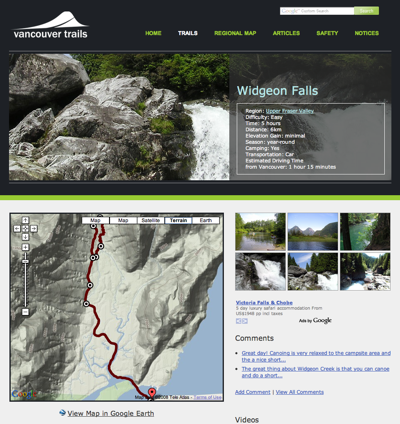
First, Michael Chang, who worked on HelloBC for many years. He is now the owner and operator of El Chango Media launched the new design for Vancouver Trails. This website not only looks gorgeous, it also provides users with tons of information about the plethora of hiking trails around Vancouver.
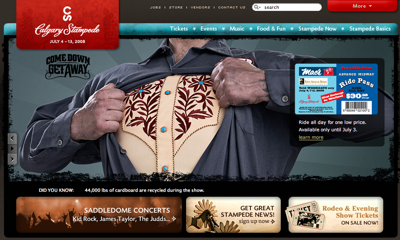
And second, Dave Wight, who spend many hours cataloging, selecting and manipulating images for HelloBC launched a redesigned website for the Calgary Stampede. I had coffee with him in Calgary a couple of weeks ago when I was there for Online Revealed and I’m happy to hear he’s enjoying his new position and the result shows.
Congratulations guys. -
Internet, Marketing, personal, tourism bc, Travel & Tourism
Couple of recent panel apperances
05.22.08 | Permalink | 7 CommentsI had the opportunity to join two panel conversations the last few weeks.
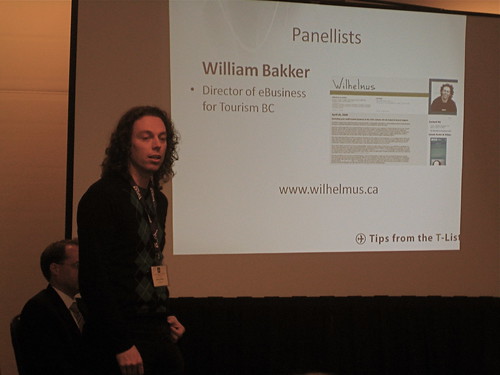
The first one was at the Online Revealed conference in Calgary where I joined Terri McCulloch, Tom Wilson,
Jens Thraenhart and Stephen Joyce. Alicia Whalen and Phil Caines did a great job moderating. I particularly like Phil’s live web servicing to show the websites we talked about. This was the third time we took the Tips from the T-List on the road and it was another great session where we discussed and debated the opportunities blogs, User Generated Content and Social Networks provide for the tourism industry. I like these sessions because I represent myself as a travel blogger and Tourism BC for our HelloBC Blogs initiative. It was the first time I met Terri and Tom, and they provided great insights. I’ve been a fan of Terri’s blog for a while now and Tom’s work is a great example of maximizing the medium with limited resources.
Thank you Patricia and Alicia from a Couple of Chicks marketing for inviting me. You’ve done a great job again.
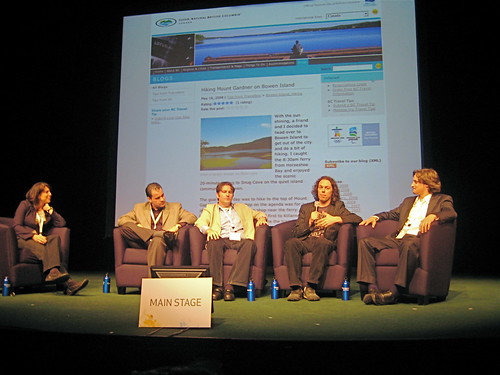
Today I joined Ben Stringfellow (Director of Internal Communications, McDonalds USA), Thierry Hay-Sabourin (Senior Ecommerce Manager, Future Shop), William Azaroff (Interactive Marketing & Channel Manager, Vancity) on a panel called ‘Giving Your Brand Away’ at the Convergence 2008 conference. It was a pleasure to share the stage with this diverse group who’ve all done great things with building communities.
Ben gave us the story and result from a brand new closed community for McDonalds’ staff, reducing cost of printing newletters and creating efficiencies through shared learning between the restaurants. William gave us the remarkable story behind the Change Everything community while Thierry provide insights into Futureshop message boards, including Aaron, the search guy.
The biggest take-away I got from the session was that the first 500 members of your community will set the tone. So it’s important that the first members set the right tone, otherwise it will be hard to recover from that. Thierry shared that the tone on the English boards is very different from the French boards for example. At our HelloBC Blogs, we accidentallyThak did the right thing by starting our efforts with staff and our visitor centres, who set the right tone for consumers. Sometimes you need a bit of luck.
Thank you Sandy from Fjord Interactive for inviting me and a great conference. -
personal
Awesome Touch Screen Interface from Tokyo’s UT store
While looking for a cool Japanese t-shirt last week I came across this touch screen interface at Tokyo’s UT store. This store is awesome. They sell designs for only a month. The shirts are sold in tubes and the store layout and artworks are replaced every month as well. This touch screen allows you to browse the store inventory in a very cool and interactive way. Their website is pretty interesting as well.
-
personal
The unfair process of the US primary
Once in a while I’d like to digress from travel, technology and marketing on my blog. I have other interests and one of them is politics.
The US presidential election fascinates me on a lot of levels. In a lot of ways its great. It takes so long that there’s no way you won’t understand the differences between the candidates at the end of the process. Compared to Dutch and Canadian politics where election season is limited to a couple of months or so.
What I don’t understand is why I haven’t heard anybody talk about the complete unfairness of spreading the primary elections over months. Currently, there’s a lot of talk that Clinton should quit the process so the democrats can focus on the general elections. The reasons for this is that Obama is ahead in the delegate race, has won more states and has a majority lead in the popular vote.
This is based on the schedule of the elections. A candidates momentum is based on the last primary. Take the democrats for example. Obama won the first, causing huge media attention. Clinton won the second, and the momentum shifted to her. And on and on it went. Then other candidates started dropping out.
Maybe one of the other candidates could have won a state with an election months later. Just because Iowa and New Hampshire are first, it means that if you don’t appeal to these states, you’re done because the momentum has now swung to other candidates. Not fair to people living in other states who might like that candidate.
And imagine if the schedule of the primaries would have been something like New Hampshire, Arizona, Ohio, Rhode Island, California. These states were all won by Clinton. Obama would probably been forced to drop out; Clinton’s momentum would have been to much.
Montana and South Dakota (the last democratic primaries on June 3) probably won’t matter anymore. And if they do, it’s because of the extraordinary year for the democrats. The voters in these state essentially don’t have a say in the election of their party’s candidate. I seriously don’t get it. -
Internet, personal, Travel & Tourism
Travel Bloggers Summit
03.05.08 | Permalink | 4 CommentsThe Travel Blogger Summit was great yesterday. Just like Orlando, we had a lot of turnout for the blogger private meetings. The discussions were great. Not just about blogging, but we talked about a range of relevant topics that’s impacting the travel industry. It was really nice to have a bunch of smart people in the room to share thoughts with.
The workshops were well attended. We had a Phocuswright style session, complete with the professional AV set-up. The panalists were very diverse, both from different areas of the industry as well as different countries. Jens and Yeoh Siew from Shyventures did a good job moderating. I received great feedback from the audience including some who emailed me since (thanks for emailing me the picture below Barrett)
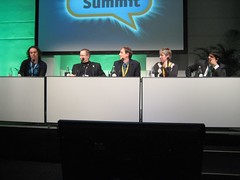
On the workshop pannel.
Next time I think we can make the sessions even better if we take some of the conversation from the private sessions and take them into the workshops. Either by introducing an unconference format, or by having the panelists talk about the topics of their blog. I think people were checking out a bit after two hours of bloggers talking about blogging 😉
Now it’s 5:30am and I’m wide awake again and hungry. Gotta love a jet-lag. Breakfast in one hour. -
Internet, personal
First Workshop started at Phocuswright Bloggers Summit
03.05.08 | Permalink | 2 Comments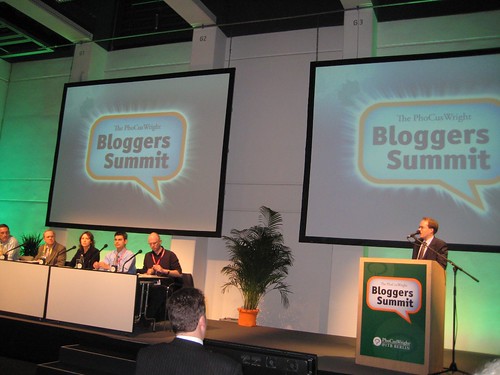
There are two workshops happening today. I’ll be on the second panel. The first panel just started and the only reason I’m posting this is because they will show my blog on the screen later and I’d like to have this picture up there 😉
There’s a lot of interest it seems, there are a large number of people attending. -
Internet, personal
Bloggers vs. Journalists
03.02.08 | Permalink | 2 CommentsThe subject of this post is the panel I will be participating in during the workshop at the Phocuswright bloggers summit in Berlin on Wednesday. I don’t think it’s an us vs. them at all. There’s a place for both.
Journalism is turning data into knowledge. A journalist has the tools and skills to gather all information (the data), get to the core and communicate his/her conclusion. I always learn a lot from traditional media when I don’t know too much about something.
The bloggers I like either give me their knowledge, their opinion, or data I can use to gain knowledge. Often the value is the conversational aspect. Even though they might not posses the communication skills a journalist possesses, their subject matter expertise compensates for it.
I’ve been on similar panels before and the editorial argument often comes up. This is interesting because it touches upon the editorial team vs. the wisdom of crowds. And both work, for different purposes. I trust the BCC or NY Times to tell me the most important news. I trust Digg or Techmeme to let me know what’s most popular or what’s discussed the most.
Times have changed, and will continue to change. The key is to embrace change find your new role, models to operate under and the opportunities that comes with it.
I look forward to the discussion on Wednesday, and I hope to see you there.
» Next Entries

William Bakker's Destination Marketing blog
William Bakker is Chief Strategist at Destination Think!. These are my personal thoughts.